
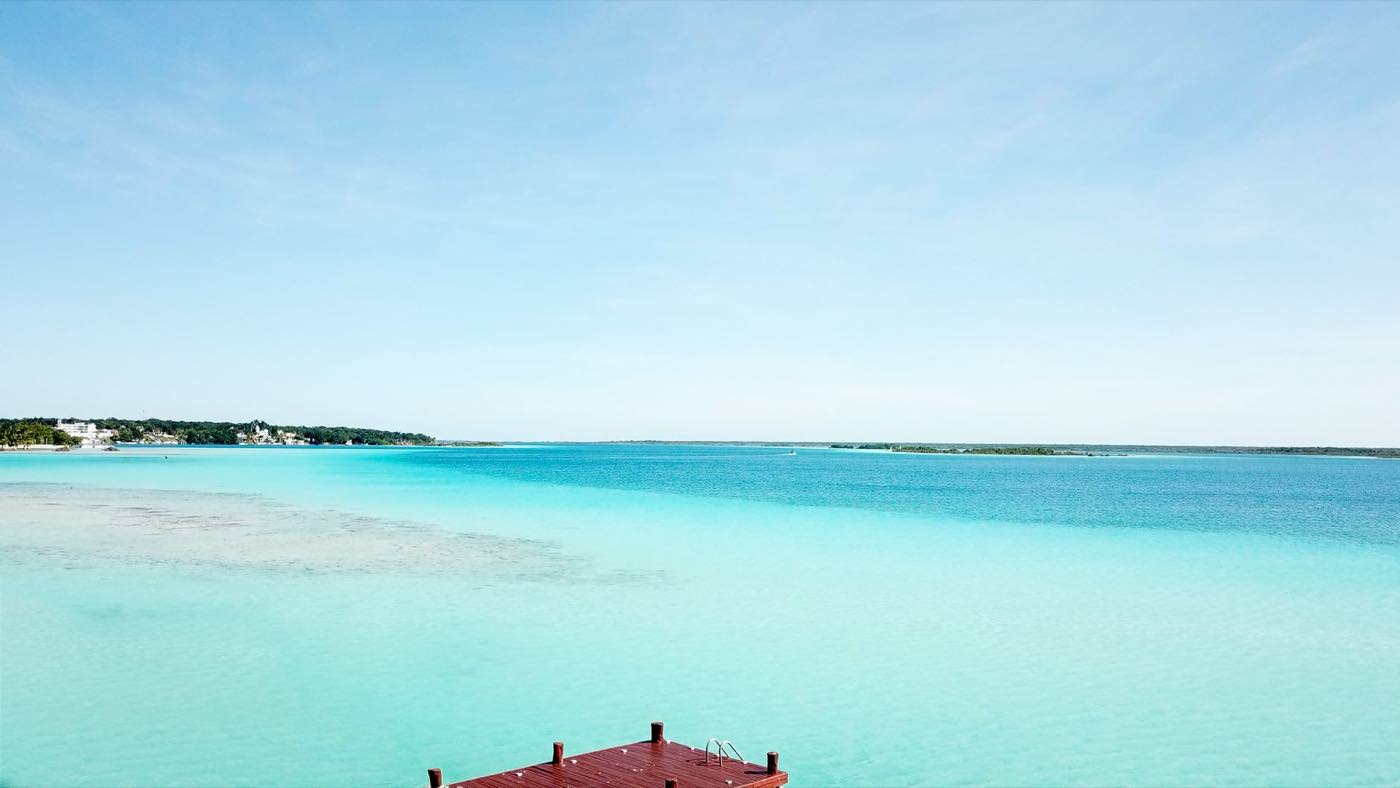

The Bacalar lagoon, in southern Quintana Roo, Mexico (not the other Playa del Carmen, the one in Lanzarote), is the most beautiful body of fresh water on the peninsula and one of the very few places on this coast where sargassum simply cannot reach. It is also far: about 280 km, 174 miles, and 3 hr 50 min to 4 hr 10 min by bus from Playa del Carmen, in each direction. That is the number to settle before you look at a single photo of a hammock over turquoise water. Below: how to get there, how many nights to book, what the boat tours, Los Rápidos and Cenote Azul cost, and the rules that protect the stromatolites.
Bacalar from Playa del Carmen: 174 miles and 4 hours, each way
Bacalar is about 174 miles (280 km) south of Playa del Carmen on federal highway 307, which works out at 3 hr 50 min to 4 hr 10 min by bus depending on the service, and 3 hr 30 min to 4 hours by car. Going down and back in one day therefore costs you 7 to 8 hours of travel for 5 or 6 hours on the ground, with a departure before 6 am and a return after 10 pm.
Our position is blunt: the day trip is a bad idea, and it is the main problem with the tours sold along Quinta Avenida. You arrive around 11 am, under vertical sun, at the busiest and most boat-churned hour of the day, and you miss the two moments that made Bacalar famous, sunrise on mirror-flat water and late afternoon. Put it next to the other trips from Playa, Tulum at 40 miles, Cancún at 42 miles, Chichén Itzá at 112 miles, and Bacalar is clearly in a different bracket. The day trips that genuinely work are in our guide to things to do in Playa del Carmen, and Bacalar is not one of them.
How many nights to spend in Bacalar
Two nights is the format that works: leave Playa late morning, arrive mid afternoon, then an evening, one full day and a second morning before the bus back.
- One night (2 days): doable, but tight. You get either the boat tour or Los Rápidos and Cenote Azul, not both without rushing.
- Two nights (3 days): the right rhythm. Day 1 the fort and sunset, day 2 kayak at dawn then the boat tour, day 3 Cenote Azul before the early afternoon bus.
- Three nights or more: only justified if you carry on to Chetumal, Belize or the Kohunlich ruins, 43 miles west.
Book accommodation early from December to March. The town is small and the lagoon-front hotels fill up weeks ahead.
The ADO bus: the simplest option, 491 to 625 pesos
The bus is the best way to reach Bacalar without a car: 15 to 20 departures a day, from 00:20 to 21:40, at 491 to 625 pesos (about $29 to $37) depending on the company and the class.
- ADO: from about 564 pesos ($33), the standard class, and the most frequent by far.
- ADO GL: from about 625 pesos ($37), wider seats, which matters over 4 hours.
- AU: from about 491 pesos ($29), the cheapest, slightly slower, and only a handful of departures.
- Duration: 3 hr 50 min on the fastest service, 4 hr 10 min on average, with one stop in Tulum and no change of bus.
- Departure: Terminal Alterna, Avenida 20 at Calle 12 Norte, not the small tourist terminal on Quinta Avenida. About 10 minutes on foot from the centre, or 60 to 80 pesos ($4 to $5) by taxi.
- Arrival: Bacalar bus station, 600 m from the fort, a 10 minute walk.
Night bus or day bus? The day bus, without hesitation. The 00:20 and 02:00 departures drop you before dawn with no room available until 3 pm and nothing open. Book on the ADO site 2 to 5 days ahead in high season, when the 9:40 and 10:40 seats go first. High season can also push fares up by as much as 30 percent over the base price.
Renting a car: freedom, at 600 to 1,000 pesos a day
A car earns its place if you continue to Kohunlich, the Costa Maya or Mahahual. Otherwise the bus stays simpler and cheaper for two people. Budget 600 to 1,000 pesos a day (about $32 to $54) before insurance, plus roughly 1,000 to 1,300 pesos of fuel ($54 to $70) for the round trip, with Magna running near 25 pesos a litre in Quintana Roo.
Past Tulum, highway 307 narrows to two lanes with very aggressive topes at the entrance to every village. Two rules: do not drive at night, and carry cash, because some Pemex stations will not take a card.

The Maya Train: no reliable direct service from Playa del Carmen
At the time of this update, no published timetable puts a dependable direct train between Playa del Carmen and Bacalar. The Playa station has taken passengers since March 15, 2024, but it sits inland, 6 to 10 km from the tourist centre, about 100 pesos ($6) by taxi, and the southbound runs to Chetumal are timetabled out of Cancún Airport.
- Two southbound circulations a day from Cancún Airport toward Chetumal, calling at Bacalar, around 9:00 am and 3:30 pm.
- About 4 hr 40 min from Cancún to Bacalar, longer than the bus from Playa, before you even count getting to Cancún airport.
- The Cancún to Playa del Carmen segment restarted on August 18, 2026, with four daily departures, two in each direction, and a 49 minute run. Some unofficial timetables show the southbound service calling at Playa around 9:50 am and reaching Bacalar around 1:40 pm, but the operator's own schedule page does not publish that pairing.
- Dynamic pricing since March 2025: there is no fixed fare any more, the amount depends on the date and how far ahead you book.
- Bacalar station is outside the village, so you need a taxi on arrival.
Our position is clear: in 2026, from Playa del Carmen, the train is not a reliable option for Bacalar. Timetables move, services are added and then suspended, and one missed connection costs you half a day. Check the official ticket site for your own date before you count on it, and keep the bus as the default.
The three options compared
| Option | Duration | One-way price | Frequency | Who it suits |
|---|---|---|---|---|
| ADO / ADO GL bus | 3 hr 50 min to 4 hr 10 min | 564 to 625 pesos ($33 to $37) | 15 to 20 a day | Everyone, the default choice |
| AU bus | About 4 hr 10 min | From 491 pesos ($29) | A few departures | Tight budgets |
| Rental car | 3 hr 30 min to 4 hours | 600 to 1,000 pesos a day ($32 to $54) | Whenever you like | Anyone continuing to Mahahual or Kohunlich |
| Maya Train | 4 hr 40 min from Cancún | Variable fare | 2 circulations a day | Nobody starting from Playa, as the service stands |
Why the water in Bacalar has seven colors
The colors come from three things working together: a bed of very pale limestone sediment, a depth that swings from a few inches to more than 295 feet, and submerged cenotes punched into the floor of the lagoon.
Over the shallows, light passes through the water, hits the white sediment and bounces back: that is the pale turquoise. Further out, the water column thickens and absorbs the reds, so the blue slides toward indigo. Above a cenote the bottom drops away to 100, 200 or 295 feet and the patch turns almost black. The seven colors are a continuous gradient, in other words, not seven separate zones. It is the same physics you see in the cenotes along the coast, explained in our guide to the cenotes near Playa del Carmen.
The boat or sailboat tour: 500 to 650 pesos
This is the one activity to do if you only do one, and the sailboat is worth the premium. Shared departures run 400 to 800 pesos per person (about $22 to $43), most commonly 500 to 650 pesos ($29 to $38) for 3 to 4 hours. Private charters start around 2,000 to 3,500 pesos ($118 to $206) for 4 to 8 people, and a private sailboat for two starts near 3,100 pesos ($183).
The classic route takes in the Pirates Channel, Bird Island and the stromatolite zones. Life jacket and guide are usually included; mask, access fees and food almost never are, so ask for the breakdown before you pay. The sailboat is silent and does not stir the sediment; the lancha covers more ground in less time. Either way, book the departure that leaves before 9 am.
Sunrise kayaking: 150 to 200 pesos an hour
Dawn kayaking is the best value in Bacalar and the only activity that disturbs nothing: before 8 am there is not a single motorboat on the water. The rental shacks along the lagoon front open around 7 am and charge 150 to 200 pesos an hour (about $8 to $11) for a single, or roughly 600 pesos ($35) for a full day, which in practice means six hours from pick-up. Doubles run closer to 250 to 400 pesos an hour. Plenty of hotels lend their kayaks for free, so check before you book anything.
Los Rápidos: 200 pesos, and a visit to do properly
Los Rápidos is a narrows in the lagoon where the current carries you a few hundred metres, about 8 miles (13 km) southwest of the village. Entry is 200 pesos per adult (about $11), life jacket included, cash only, with parking at 50 pesos and no lockers on site. Kayaks rent from around 100 pesos an hour.
It is also where tourism has done the most damage: the bed of the channel is paved with stromatolites that years of foot traffic have wrecked. So you go in with a life jacket, no fins, inside the marked channel, and you never put a foot on a formation. If you are not prepared to respect that, skip it. Arrive at opening, because the site is small and loud by midday. Reckon on 150 to 250 pesos ($9 to $15) for a taxi, negotiated with the return leg included.
Cenote Azul: 25 to 30 pesos, the best value in the area
Cenote Azul is the cheapest and most spectacular thing near the village: 25 to 30 pesos to get in (about $1.50), open every day from 10 am to 6 pm, 2.5 miles south of town on the Chetumal road.
- Depth: about 295 feet (90 m) across a 660 foot (200 m) circle. You swim over nothing, with no floor in sight.
- Life jacket: about 50 pesos ($2.70). Not optional, since there is nowhere to stand.
- On site: restaurant, shaded tables, a dock and a jumping platform. Kayaks for about 150 pesos.
- The catch: the water is noticeably colder than the lagoon, and the place fills after midday.
- Getting there: 100 to 150 pesos ($6 to $9) by taxi from Bacalar, or 30 minutes by bike.
Fort San Felipe: 110 pesos and a real pirate story
Fort San Felipe has looked down on the lagoon since 1733, built against the English pirates who came up the Río Hondo to loot logwood. Its museum is the best cultural hour in town.
- Hours: Tuesday to Sunday, 9 am to 7 pm. Closed Monday.
- Prices: 110 pesos (about $6) for foreign visitors, 55 pesos for Mexican adults, 30 pesos for children, teachers and seniors. Free on Sundays for Mexican nationals.
- Address: Avenida 3, between calles 20 and 24, right in the centre.
- Allow: 45 minutes to an hour, for Maya pieces, old charts and colonial weapons.
Go in the last hour before closing. The low light across the lagoon from the ramparts is worth the ticket on its own.
The balnearios: lagoon access for 30 to 50 pesos
The shore is almost entirely private, split between hotels and paying balnearios. Two places open to everyone:
- Balneario Ejidal Mágico: the cheapest access on the lagoon, 30 pesos per adult (about $1.60) and 10 pesos for children aged 4 to 10, 10 am to 6:30 pm, cash only, last kayak rental at 5 pm. Docks, shade, toilets, showers, changing rooms and free parking.
- Cocalitos: about 50 pesos per person ($2.70), Tuesday to Sunday, 10 am to 5 pm, famous for the stromatolites you can see straight from the walkways, with a two hour pontoon trip at around 300 pesos ($18). Stay on the marked walkways: the formations break the surface by only a few centimetres.
Stromatolites, engines and sunscreen: the rules to know
The stromatolites of Bacalar are living formations, built layer by layer by colonies of cyanobacteria, and among the largest freshwater examples known. They grow a few millimetres a year, so one foot placed on them destroys decades. The municipal rules are explicit:
- Keep at least 3 metres (10 feet) away from the stromatolites, and look without touching.
- Never climb on them, sit on them, moor to them or beach a boat on them.
- No sunscreen in the lagoon, biodegradable included. This is the least known rule: even a biodegradable formula adds nutrients that speed up eutrophication, the process that turns the water green. The answer is clothing, a long-sleeved rash guard and a hat, with sunscreen applied after you swim, away from the water.
- No scrubs made from lagoon sediment, a practice some guides still sell and which is banned.
- Do not touch the chivita snail, the reeds or the mangrove. No litter, no loud music.
New navigation rules. The Chetumal and Bacalar port captaincy has drawn up a set of general navigation rules for the lagoon, presented to operators in 2025 and awaiting publication in the federal gazette. They split the water into five zones: a caution corridor up to 50 metres from shore for swimmers at a maximum of 4 knots, a low-speed zone at 10 knots, towing and jet-ski zones at up to 20 knots with one-way circulation, and a restricted zone covering Los Rápidos and the Pirates Channel where only authorised vessels pass. They also create absolute-protection subzones along the Bacalar and Xul-Ha shores, where all navigation and contact is banned, and a 300 metre silent radius around Bird Island. Turning the lagoon into a formally protected natural area, an ANP, was explicitly ruled out.
The engine debate. Motorboats are accused of stirring sediment, polluting and damaging the formations, and the question splits the town between conservation and local income. There has been movement: according to the regional press, the large majority of the cooperatives' lanchas have swapped two-stroke engines for cleaner four-strokes. Our advice: favour the sailboat, the kayak or the paddleboard, and if you do take a lancha, pick an operator who states a four-stroke engine.
When to go, and what the water really looks like after rain
The best window runs from November to April, peaking from January to March: little rain, clear water, bearable heat. The rainy season runs June to October, with June the wettest month.
Here is what rarely gets said: after heavy rain, the lagoon loses its colors. Runoff carries sediment that browns it for several days, and an excess of nutrients, tied to poorly treated wastewater, deforestation and farm chemicals across the catchment, turns it green in episodes. UNAM researchers have documented that loss of color, and the municipality has put forward a project for five absorption wells meant to filter rainwater before it reaches the lagoon. So if you travel between June and October, look at recent photos from the hotels and kayak rentals before you commit to two nights. The seasonal logic of the whole region is set out in our guide to the best time to visit Playa del Carmen.
Zero sargassum in Bacalar: the plan B from April to August
Bacalar is a freshwater lagoon with no connection to the Caribbean Sea, so sargassum cannot get there. That makes it the strongest plan B from April to August, the stretch when the coastal beaches take the worst of it, as we track in our guide to sargassum in Playa del Carmen. The trade-off: these are the hottest months and, from June onward, the wettest. You swap seaweed for humidity and evening mosquitoes. In April and May that is an excellent deal.
Keep going


Frequently asked questions
Can you visit Bacalar as a day trip from Playa del Carmen?
Technically yes, but we advise against it. It is about 174 miles and 3 hr 50 min to 4 hr 10 min by bus each way, so 8 hours of travel for 5 or 6 hours on the ground, arriving at the worst hour of the day. Plan two nights, or one at the absolute minimum. If you only have a free day, a closer trip is a better use of it: see things to do in Playa del Carmen.
How much does the bus from Playa del Carmen to Bacalar cost?
From 491 to 625 pesos one way (about $27 to $34): around 564 pesos on standard ADO, 625 pesos on ADO GL and 491 pesos on AU. There are 15 to 20 departures a day, from 00:20 to 21:40, from the Terminal Alterna on Avenida 20 at Calle 12. The fastest service takes 3 hr 50 min. Book 2 to 5 days ahead from December to March, when fares can also rise by up to 30 percent.
Does the Maya Train go from Playa del Carmen to Bacalar?
Not as a dependable direct service. Playa del Carmen station has taken passengers since March 2024, and the Cancún to Playa segment restarted on August 18, 2026 with four daily departures, but the southbound runs to Chetumal are timetabled out of Cancún Airport, two a day, about 4 hr 40 min to Bacalar. Fares have been dynamic since March 2025. Check the official ticket site for your date and keep the bus as the default.
Can you wear sunscreen in the Bacalar lagoon?
No, not even biodegradable. The municipal rules ask you not to swim in the lagoon wearing sunscreen, because it adds nutrients that speed up eutrophication. Wear a long-sleeved rash guard and a hat, and apply sunscreen after you swim, away from the water. It is the same logic as the cenotes, where a rinse-off shower before entering is compulsory.
Is there sargassum in Bacalar?
None at all. Bacalar is a freshwater lagoon with no link to the Caribbean Sea, so sargassum cannot reach it. That is exactly what makes it the best plan B from April to August, when the coast is affected, as we explain in our tracker for sargassum in Playa del Carmen.
Book your activities
Experiences to compare and book directly, without leaving the site.
Partner link. Booking through it doesn't change your price and supports the guide.
